
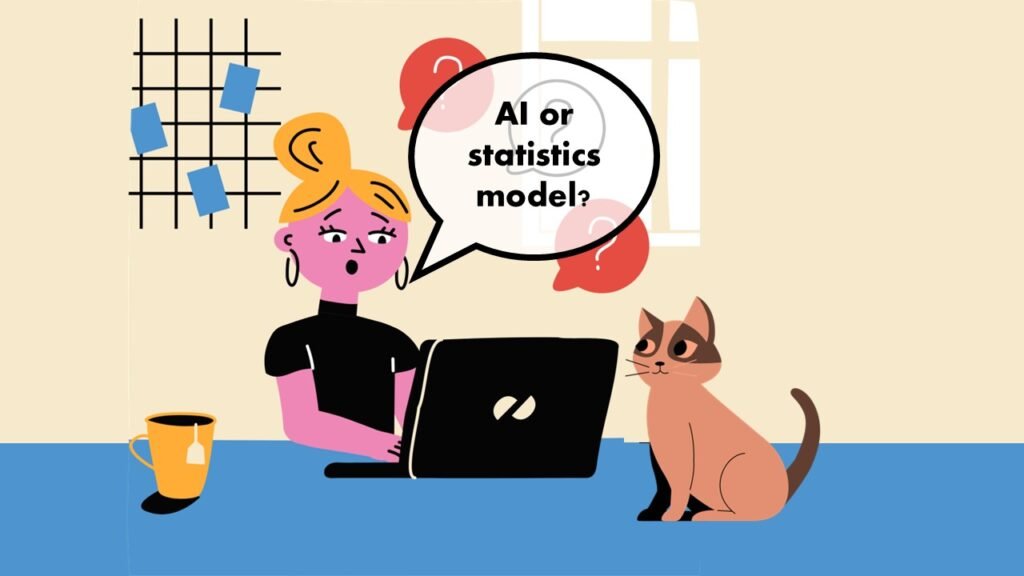
AI or statistics – two different modeling approaches. Of course, they are not mutually exclusive, in that artificial intelligence (AI) models developed through machine learning (ML) obviously involve statistics, and to make a solid AI model, you have to start by doing some statistical analysis. But if you are trying to publish a scientific paper, and you are considering using a big enough dataset, you are forced to pick your focus in the paper – AI or statistics?
In fact, I’m quite good at making the “AI or statistics” choice in my scientific papers, and defending my choice. This is because I’ve recently had reviewers try to push me into making an AI model when I should be using statistical analysis to meet my research objective. It bothered me so much, I wrote a paper about it, and I’ll summarize a few salient points here.

AI or Statistics: Why We Have to Ask this Question
Today, it is operationally relatively easy to fire up R, KNIME, Python, or many other programs and run an AI model on some big data you can download from Kaggle or some other source. But just because you have a hammer, not everything is a nail. If you are trying to apply the scientific method to answer a research question, using an AI model won’t get you there. On the other hand, if you are trying to develop an operational model that most accurately predicts electrical load on an energy system, developing a deployable AI model is the better way to go.
The figure below – adapted from our paper – summarizes the differences in how AI models and statistical models are developed.
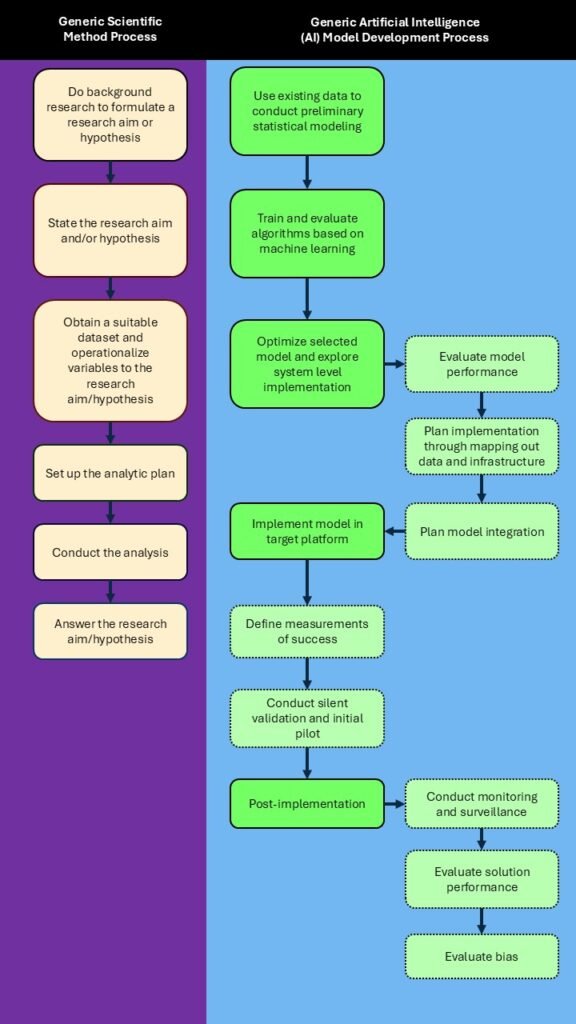
The figure is relatively complex, but the takehome message is that statistical models are developed to answer a research question, and AI models are developed to actually be deployed in an operational setting – which is much more involved, as you can see by the figure.
What’s Wrong with Using AI to Answer a Research Question?
I’m not an AI researcher, I’ll admit. I’m a statistician. Actually, I’m an epidemiologist, so the main thing I do is scientific research – which is I pose hypotheses and research questions a priori, then I go get some data, and analyze it to answer them. This is why it annoys me each time a reviewer recommends that I use an AI model instead of statistical analysis to answer a research question.
As we say in our paper, I admit that often, an AI model developed from the same data as my statistical model is likely able to make a more accurate prediction. However, that is not your goal when you are applying the scientific method. The goal in research using the scientific method is to build a statistical model that is interpretable, so that you can explain and interpret the relationships you find. Most AI models are rather “black box” – meaning they are generally uninterpretable and impossible to explain. There has been a push for “explainable” AI (XAI), and this is ethically necessary if you want to use AI models for making decisions that have important public implications (like choosing whether to allow an immigrant into a country, or a prisoner out of jail). But even an XAI model is not appropriate for answering a research question.
Our paper points out other problems with using an AI model as an answer to a hypothesis using the scientific method, such as the fact that you can put variables in an AI model that make no sense scientifically, AI models that are developed through an automated process can’t be adequately explained (nor replicated), and AI models do not need to take into account issues around sampling that are necessary for answering research questions with statistics.

Okay, So When Should You Use an AI Model in Your Scientific Publication?
I’m glad you asked! There are two main scenarios where you should develop an AI model for a scientific publication.
Develop an AI Model When Exploring Relationships
AI modeling is a good way to explore your large dataset. Of course, I’d first recommend you do some basic descriptive statistics (in R, SAS, or some other program) just to get to know your variables. But after that, playing with your data using AI models can help you quickly understand how the variables are working together, and where underlying relationships are. Exploratory research is not hypothesis-driven – but it can lead to the formation of important hypotheses that are worth testing that you might not have thought of yourself.
Develop an AI Model to Solve an Operational Problem
AI models are used all the time now. When you type into WhatsApp, it can often accurately predict the next word you are going to say using an AI model. AI models in marketing software can guide you as to the optimal time to send out your e-mail blast.
Because AI models are developed for operational use, it may not be top-of-mind that these models could be the subject of research published in scientific journals. However, studies on best practices with respect to developing, optimizing and deploying these models are important to conduct and publish to push science forward. As shown in the figure above, there are many steps to developing and deploying an operational AI model. If you make a solid contribution to the scientific literature with respect to these processes, it will be greatly appreciated by someone who is trying to do them.
Read all of our data science blog posts!
AI or Statistics – Which Modeling Approach Should You Use?
AI or statistics – two different, interrelated approaches you can use in your scientific publication. [...]
Sep
Confidence Intervals are for Estimating a Range for the True Population-level Measure
Confidence intervals (CIs) help you get a solid estimate for the true population measure. Read [...]
1 Comment
Jun
Continuous Variable? You Can Categorize it!
Continuous variable categorized can open up a world of possibilities for analysis. Read about it [...]
2 Comments
Jun
Delete if the Row Meets Criteria? Do it in SAS!
Delete if rows meet a certain criteria is a common approach to paring down a [...]
May
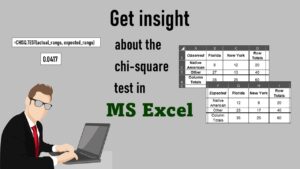
Chi-square Test: Insight from Using Microsoft Excel
Chi-square test is hard to grasp – but doing it in Microsoft Excel can give [...]
May
Identify Elements of Research in Scientific Literature
Identify elements in research reports, and you’ll be able to understand them much more easily. [...]
May
Design the Most Useful Time Periods for Your Conversions
Time periods are important when creating a time series visualization that actually speaks to you! [...]
Apr
Apply Weights? It’s Easy in R with the Survey Package!
Apply weights to get weighted proportions and counts! Read my blog post to learn how [...]
Nov
Make Categorical Variable Out of Continuous Variable
Make categorical variables by cutting up continuous ones. But where to put the boundaries? Get [...]
Nov
Remove Rows in R with the Subset Command
Remove rows by criteria is a common ETL operation – and my blog post shows [...]
Oct

CDC Wonder for Studying Vaccine Adverse Events: The Shameful State of US Open Government Data
CDC Wonder is an online query portal that serves as a gateway to many government [...]
Jun

AI Careers: Riding the Bubble
AI careers are not easy to navigate. Read my blog post for foolproof advice for [...]
Jun

Descriptive Analysis of Black Friday Death Count Database: Creative Classification
Descriptive analysis of Black Friday Death Count Database provides an example of how creative classification [...]
Nov
Classification Crosswalks: Strategies in Data Transformation
Classification crosswalks are easy to make, and can help you reduce cardinality in categorical variables, [...]
Nov

FAERS Data: Getting Creative with an Adverse Event Surveillance Dashboard
FAERS data are like any post-market surveillance pharmacy data – notoriously messy. But if you [...]
4 Comments
Nov
Dataset Source Documentation: Necessary for Data Science Projects with Multiple Data Sources
Dataset source documentation is good to keep when you are doing an analysis with data [...]
Nov

Joins in Base R: Alternative to SQL-like dplyr
Joins in base R must be executed properly or you will lose data. Read my [...]
Nov

NHANES Data: Pitfalls, Pranks, Possibilities, and Practical Advice
NHANES data piqued your interest? It’s not all sunshine and roses. Read my blog post [...]
Nov

Color in Visualizations: Using it to its Full Communicative Advantage
Color in visualizations of data curation and other data science documentation can be used to [...]
Oct

Defaults in PowerPoint: Setting Them Up for Data Visualizations
Defaults in PowerPoint are set up for slides – not data visualizations. Read my blog [...]
Oct
Text and Arrows in Dataviz Can Greatly Improve Understanding
Text and arrows in dataviz, if used wisely, can help your audience understand something very [...]
Oct
Shapes and Images in Dataviz: Making Choices for Optimal Communication
Shapes and images in dataviz, if chosen wisely, can greatly enhance the communicative value of [...]
Oct

Table Editing in R is Easy! Here Are a Few Tricks…
Table editing in R is easier than in SAS, because you can refer to columns, [...]
Aug
R for Logistic Regression: Example from Epidemiology and Biostatistics
R for logistic regression in health data analytics is a reasonable choice, if you know [...]
272 Comments
Aug

Connecting SAS to Other Applications: Different Strategies
Connecting SAS to other applications is often necessary, and there are many ways to do [...]
Jul

Portfolio Project Examples for Independent Data Science Projects
Portfolio project examples are sometimes needed for newbies in data science who are looking to [...]
Jul

Project Management Terminology for Public Health Data Scientists
Project management terminology is often used around epidemiologists, biostatisticians, and health data scientists, and it’s [...]
Jun

Rapid Application Development Public Health Style
“Rapid application development” (RAD) refers to an approach to designing and developing computer applications. In [...]
Jun

Understanding Legacy Data in a Relational World
Understanding legacy data is necessary if you want to analyze datasets that are extracted from [...]
Jun

Front-end Decisions Impact Back-end Data (and Your Data Science Experience!)
Front-end decisions are made when applications are designed. They are even made when you design [...]
Jun

Reducing Query Cost (and Making Better Use of Your Time)
Reducing query cost is especially important in SAS – but do you know how to [...]
Jun

Curated Datasets: Great for Data Science Portfolio Projects!
Curated datasets are useful to know about if you want to do a data science [...]
May
Statistics Trivia for Data Scientists
Statistics trivia for data scientists will refresh your memory from the courses you’ve taken – [...]
Apr

Management Tips for Data Scientists
Management tips for data scientists can be used by anyone – at work and in [...]
Mar
REDCap Mess: How it Got There, and How to Clean it Up
REDCap mess happens often in research shops, and it’s an analysis showstopper! Read my blog [...]
Mar

GitHub Beginners in Data Science: Here’s an Easy Way to Start!
GitHub beginners – even in data science – often feel intimidated when starting their GitHub [...]
Feb
ETL Pipeline Documentation: Here are my Tips and Tricks!
ETL pipeline documentation is great for team communication as well as data stewardship! Read my [...]
Feb
Benchmarking Runtime is Different in SAS Compared to Other Programs
Benchmarking runtime is different in SAS compared to other programs, where you have to request [...]
Dec

End-to-End AI Pipelines: Can Academics Be Taught How to Do Them?
End-to-end AI pipelines are being created routinely in industry, and one complaint is that academics [...]
Nov
Referring to Columns in R by Name Rather than Number has Pros and Cons
Referring to columns in R can be done using both number and field name syntax. [...]
Oct

The Paste Command in R is Great for Labels on Plots and Reports
The paste command in R is used to concatenate strings. You can leverage the paste [...]
Oct
Coloring Plots in R using Hexadecimal Codes Makes Them Fabulous!
Recoloring plots in R? Want to learn how to use an image to inspire R [...]
5 Comments
Oct
Adding Error Bars to ggplot2 Plots Can be Made Easy Through Dataframe Structure
Adding error bars to ggplot2 in R plots is easiest if you include the width [...]
Oct

AI on the Edge: What it is, and Data Storage Challenges it Poses
“AI on the edge” was a new term for me that I learned from Marc [...]
Jun

Pie Chart ggplot Style is Surprisingly Hard! Here’s How I Did it
Pie chart ggplot style is surprisingly hard to make, mainly because ggplot2 did not give [...]
5 Comments
Apr
Time Series Plots in R Using ggplot2 Are Ultimately Customizable
Time series plots in R are totally customizable using the ggplot2 package, and can come [...]
Apr

Data Curation Solution to Confusing Options in R Package UpSetR
Data curation solution that I posted recently with my blog post showing how to do [...]
Apr

Making Upset Plots with R Package UpSetR Helps Visualize Patterns of Attributes
Making upset plots with R package UpSetR is an easy way to visualize patterns of [...]
11 Comments
Apr
Making Box Plots Different Ways is Easy in R!
Making box plots in R affords you many different approaches and features. My blog post [...]
Mar
Convert CSV to RDS When Using R for Easier Data Handling
Convert CSV to RDS is what you want to do if you are working with [...]
Mar

GPower Case Example Shows How to Calculate and Document Sample Size
GPower case example shows a use-case where we needed to select an outcome measure for [...]
Feb
Querying the GHDx Database: Demonstration and Review of Application
Querying the GHDx database is challenging because of its difficult user interface, but mastering it [...]
Feb
Variable Names in SAS and R Have Different Restrictions and Rules
Variable names in SAS and R are subject to different “rules and regulations”, and these [...]
Feb
Referring to Variables in Processing Data is Different in SAS Compared to R
Referring to variables in processing is different conceptually when thinking about SAS compared to R. [...]
Jan
Counting Rows in SAS and R Use Totally Different Strategies
Counting rows in SAS and R is approached differently, because the two programs process data [...]
Jan
Native Formats in SAS and R for Data Are Different: Here’s How!
Native formats in SAS and R of data objects have different qualities – and there [...]
Jan
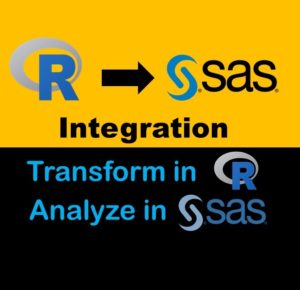
SAS-R Integration Example: Transform in R, Analyze in SAS!
Looking for a SAS-R integration example that uses the best of both worlds? I show [...]
Dec
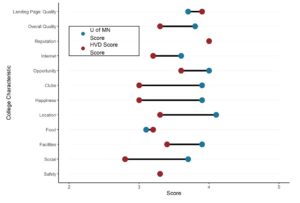
Dumbbell Plot for Comparison of Rated Items: Which is Rated More Highly – Harvard or the U of MN?
Want to compare multiple rankings on two competing items – like hotels, restaurants, or colleges? [...]
2 Comments
Sep
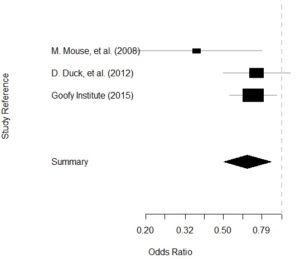
Data for Meta-analysis Need to be Prepared a Certain Way – Here’s How
Getting data for meta-analysis together can be challenging, so I walk you through the simple [...]
Jul
Sort Order, Formats, and Operators: A Tour of The SAS Documentation Page
Get to know three of my favorite SAS documentation pages: the one with sort order, [...]
Nov
Confused when Downloading BRFSS Data? Here is a Guide
I use the datasets from the Behavioral Risk Factor Surveillance Survey (BRFSS) to demonstrate in [...]
2 Comments
Oct
Doing Surveys? Try my R Likert Plot Data Hack!
I love the Likert package in R, and use it often to visualize data. The [...]
3 Comments
Oct
I Used the R Package EpiCurve to Make an Epidemiologic Curve. Here’s How It Turned Out.
With all this talk about “flattening the curve” of the coronavirus, I thought I would [...]
Mar
Which Independent Variables Belong in a Regression Equation? We Don’t All Agree, But Here’s What I Do.
During my failed attempt to get a PhD from the University of South Florida, my [...]
Aug
AI or statistics – two different, interrelated approaches you can use in your scientific publication. But which one should you pick? Read my blog post and find out!
