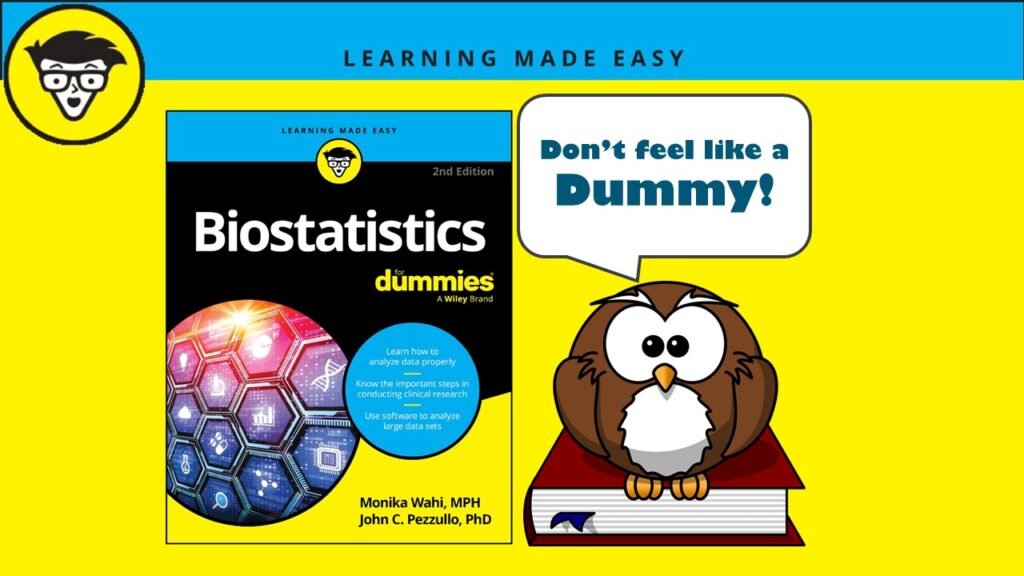
“Biostatistics for Dummies” is a popular selection among Wiley’s famous “for Dummies” series – but did you know it was upgraded in 2024? The original author, John Pezzullo, must have been an amazing professor, because the first edition of the Biostatistics for Dummies book was already very popular.
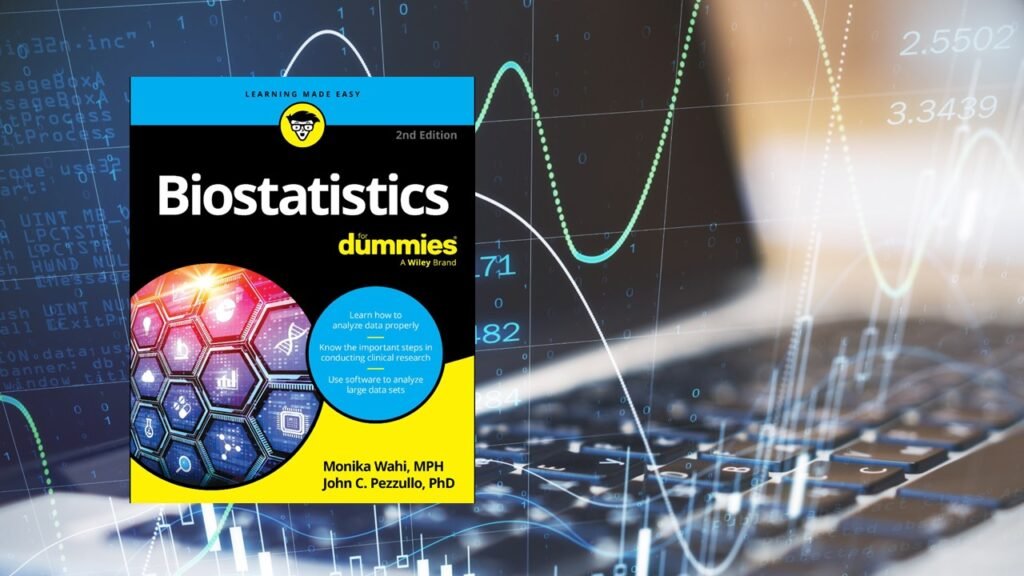
Sadly, Dr. Pezzullo passed away before he was able to revise it to a second edition. I was very honored to be awarded that task, and in the process, I grew to understand how useful this book could be for the working data scientist professional. I made my revisions thinking of the modern data scientist, and trying to meet their information needs.
“Biostatistics for Dummies” Features
- 25 chapters grouped into 7 parts (to make identifying the information you want easy)
- Chapters include contemporary use-cases from biostatistics and epidemiology that keep it real
- Emphasis on open source software, and inclusion of R code to help you see exactly how to do it
- Elegant visuals and diagrams by Wiley’s amazing graphics team to support your learning
- Advice on many touchy topics (such as power calculations and modeling) so you can make the right decision and look like a pro!
Why “Biostatistics for Dummies”?
The “for Dummies” series of books by Wiley are aimed at working professionals, as well as learners taking courses at the graduate school level. Wiley’s teams that help authors develop the “for Dummies” books have expertise in presenting the information in the book so that it is easily locatable, and have examples that you can immediately jump into cognitively to advance your comprehension. They also make excellent educational graphics that help illustrate complex points in a visually digestible way.
The original edition of “Biostatistics for Dummies” was already a masterpiece, because it covered just about any topic on which you might want on which to refresh your memory as part of completing a course, or revisiting what you learned in a course previously. The downside of the original was that it did not include wide coverage of typical epidemiologic concerns when doing biostatistics, like ensuring your sample is representative of the background population, or applying causal inference approaches to modeling.
To be fair, the author was not formally trained in epidemiology, and the original version was produced in 2012, when the term “data scientist” was gaining popularity. Now, data scientists – especially in the health science space – need to have a decent grasp of both study design and statistics. Therefore, the additional topics covered in the new release will make it more usable to a reader who is trying to execute every step of the research pipeline correctly – not just the biostatistics part.
How to Use this Book
The Dummies series are developed to be reference books, so they are intended to be used that way. This means that they are not intended to be textbooks in and of themselves – rather, they are a supplement to textbooks and other coursework you may have experienced along your learning journey.
If you are in the following audience, you will likely gain a lot of guidance from this book.
New professional: You have just completed your course of training, and now are applying your skills in the real world. If you feel a little rusty – like you have trouble remembering exactly how to do a particular regression – this book will give you the guidance you need.
Graduate student: You are currently in a data science or statistics course of study, but you are having trouble understanding the assigned textbook, and the homework is not really helping. Looking up the topic in this book will give you another angle on the same topic (that is hopefully more easily understood for you).
Self-learner: You either are learning statistics on your own, or you learned it a long, long, time ago, and it’s not easy to recall well enough to get back into it cognitively. You can look of a topic in the book and get guidance and examples, along with context. The book has a lot of self-references, so you can skip around the book and piece together a statistical context you may have not perceived in self-learning, or forgotten because you learned it so long ago.
Check out my courses and books!
Biostatistics for Dummies: The Thinking Data Scientist’s Quintessential Professional Reference
“Biostatistics for Dummies” is the thinking data scientist’s essential reference. Check out the updated 2024 [...]
Sep
Data Curation Course: Learn Data Curation Online from LinkedIn Learning!
Curation files are especially helpful for communicating about data on teams. Learn more about what [...]
Oct
Study Design Courses: Online Learning about Research Methods
Study design courses that you can access online will hand you a framework for research [...]
Sep

Learn R Online: Take it at Your Own Pace
Learn R online and tackle statistical problems easily with open source software! Take my LinkedIn [...]
2 Comments
Sep
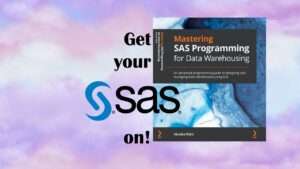
Announcing the Publication of my New SAS Book on Data Warehousing
SAS is known for big data and data warehousing, but how do you actually design [...]
Oct

Learn SAS Online, and Expand your Career Opportunities
Learn SAS online, and extend your expertise so you can take on new projects. Take [...]
Sep
Testimonials for Monika Wahi’s Linked In Data Science Courses
Testimonials for Monika Wahi’s data science courses on LinkedIn Learning are posted here. Read what [...]
Apr
“Biostatistics for Dummies” is the thinking data scientist’s essential reference. Check out the updated 2024 version, which adds epidemiologic inference topics and modeling advice!
